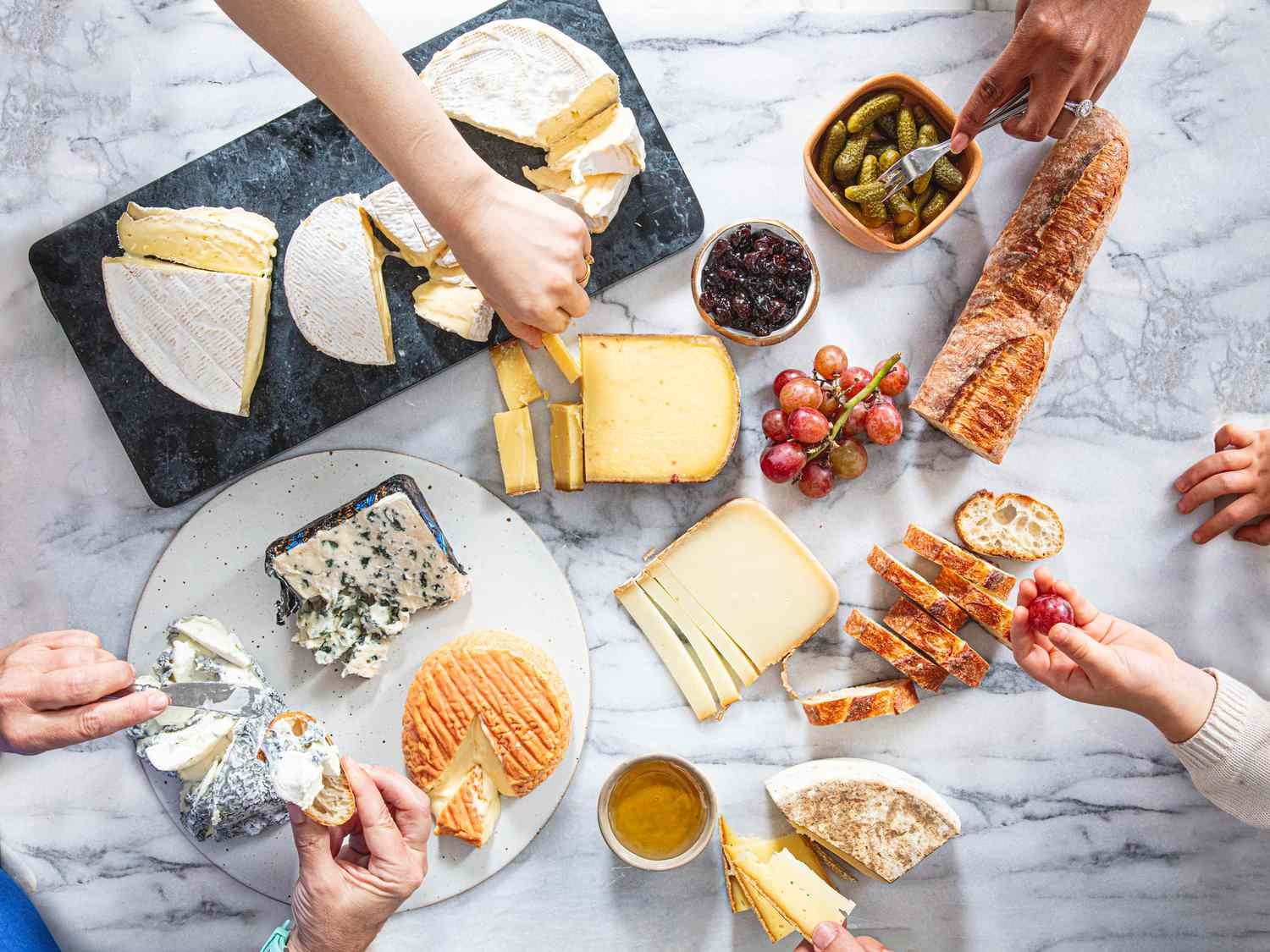
Americans love cheese. But let’s be real: we usually eat it melted on pizza, stuffed in burritos, or crumbled on salads. We treat it as an ingredient. In France, cheese is the ingredient. Or rather, it’s the main event.
It’s common to see French locals digging into a plate of cheese with their hands, no crackers, no bread, no garnish. Just cheese.
“I would say it’s a difference in how we think about cheese culturally,” John Montez explains. He’s a certified cheese professional and training manager at Murray’s Cheese in NYC. “In the US, we’re still getting over cheese being just an ingredient. It’s a little strange to have it alone.”
It shouldn’t be strange. It’s delicious.
If you live near a decent cut-to-order shop, the best way to build the perfect French cheese board is to talk to the cheesemonger. Taste samples. “The best way to learn about cheese is by eating it,” Montez says.
But if you want to try yourself, here is the playbook.
The Rules of Engagement for a Cheese Board
You don’t need a degree in cheeseology. You just need to follow a few loose guidelines.
Stick to odd numbers
Montez starts with three to five cheeses. Why? Visuals. Odd numbers look better on a plate. It feels balanced. Even numbers feel too symmetrical. Too planned.
Mix textures and milk types
A classic French trio looks like this:
1. A hard or semi-firm cheese (like Comté).
2. A soft cheese (like Brie).
3. A blue cheese (like Roquefort).
Mix up the milk sources too. Cow, sheep, goat. Variety pleases the crowd.
Exception: If you’re hanging out with industry friends, do vertical tastings. Three iterations of one type. Montez did a tasting of three blues: Roquefort, Bleu D’Auvergne (1924 Bleu). Tasting the subtle differences was cool. But if you’re hosting a dinner party for your in-laws, three blues won’t fly. Stick to variety.
Respect the seasons
Montez is a hardass about this. Don’t serve asparagus in November. Don’t serve cheese in July if it’s supposed to be a winter cheese.
In spring and summer, goats are grazing. The milk changes. The cheese tastes lighter. Go for fresh goat cheese. It’s simple. Clean.
In fall and winter? Go heavy. Savory, bloomy rind cheeses like Brie or Camembert hold up better against the colder weather. Their flavors are more robust. More complex.
Room temperature, always.
Take cheese out of the fridge at least 30–60 minutes before serving. Cold mutes flavor. It makes soft cheeses turn into rubber.
Better yet? Don’t refrigerate it at all.
“Buy what you’re going to eat that same day,” Montez says.
In France, people have specific cheese boxes to keep cheese at room temp. Why? Because once cheese leaves the aging cave, it starts to degrade. It picks up off-flavors from your fridge. It doesn’t kill you. It just tastes worse.
If you’re worried about a soft cheese leaking everywhere on the table, scoop it into a little bowl. Problem solved.
Wrap leftovers like a human
Cheese hates plastic. Wrap your slices in cheese paper. If you don’t have any, use wax paper or parchment. Never put it back in that tight plastic wrap. It suffocates the cheese.
Hard Cheeses: The Backbone
You can’t have a proper French board without a hard cheese.
Comté is the gold standard. It’s an Alpine cheese. Traditional. Beloved. Montez says if you hear a French accent walking up to the counter, his hand instinctively reaches for Comté. Every time.
- Spring/Summer: Look for 12–18 month aged Comté. Delicate nuttiness.
- Fall/Winter: Find the 2–3 year aged versions. Often labeled “salt Comté.” Heavier. Drier. More crystals. Bold flavors. Onion. Beef. Out of this world.
Tommes de Savoie is more rustic. Raw cow’s milk. Tangy. The rind is craggy and entirely edible. “You can tell just by looking at the rind that they let whatever grows on there, grow,” Montez notes. No two wheels are identical. Wild flavors.
For something different, try Ossau Iraty. A sheep’s milk cheese from the Basque region (the Pyrenees). It’s rugged. Aesthetic is different from the rest of France. If you want to expand your horizons, start here.
Mimolette is approachable. Bright orange. Butterscotch flavor. Similar to Gouda. It’s famous for the cheese mites that used to grow on its rind, digging little craters. The ones in the US get vacuum-cleaned of mites (which gives them a slight lemony note), but they’re still fun and crowd-pleasing.
Blue Cheeses: The Powerhouse
“Roquefort is the king,” Montez says. “The cheese of kings and popes.” Tangy. Raw sheep’s milk. If you have one blue, make it Roquefort.
But if you want something milder, try Bleu D’Auvergne. It’s essentially Roquefort’s cow’s milk cousin.
- Milder.
- Notes of baking spice and cinnamon.
- Versatile. Sheep’s milk blue is so fatty and creamy it’s mostly just for spreading. Cow’s milk blue? You can crumble it. Put it in a salad. Cook with it.
Montez also loves 1924 Bleu by Herve Mons. It’s a mixed-milk cheese based on an old Roquefort recipe from before the Protected Designation of Origin rules changed everything. It’s hard to go wrong with French blues. Ask your cheesemonger what they think.
Soft Cheeses: The Variety Pack
This is where you find the most variety. Mild, milky, funky, stinky.
Goat Cheese (Chèvre):
– Spring/Summer: Fresh, mild chèvre. Vermont Creamery (East) or Laura Chenel (West) do it well in the US. (Note: US laws require pasteurized milk, so these aren’t strictly equivalent to the raw-milk French versions, but they’re close.)
– Bolder Choice: Loire Valley cheeses. Try Selles-Sur-Cher. Unaged goat cheese. Ash rind. Thin cream line. Crumbly interior. Grassy. Tangy. Also look for Valencay and Sainte-Maure. Pair with a Sancerre. It knocks your socks off.
Brie and Camembert:
US law bans raw-milk cheeses under 60 days old. So you won’t find true, traditional French Brie or Camembert on most shelves. But you can find Brie Fermier or Camembert Fermier from Murray’s.
“Fermier” means farmstead. But don’t trust the label alone. These cheeses use pasteurized milk but are inoculated with cultures to mimic the breakdown of proteins found in raw-milk cheese. Result? Savory. Vegetal. Closer to the French experience.
For a US-made savory Camembert-style cheese, try Jasper Hill Farm’s Moses Sleeper in Vermont.
Triple Crème:
Want mild? Try Brillat Savarin. Gooey. Mushroomy. Butter. Or Delice. Very mild. Very well made.
Washed Rind (Funky):
This is where things get intense. Epoisses. An orangish rind. Gooey, pungent, buttery core. Meaty. Bacony.
Montez calls them “monastery cheeses” in Canada (though the term is debated). In Europe, washed rinds are believed to have originated in monasteries. The true example? Chimay cheese. Made by Belgian Trappist monks. Washed in the beer. Hard to find. Worth hunting down.
For a US alternative, try Jasper Hill Farm’s Willoughby.
The Forbidden List: Cheeses You Can’t Buy in the US
Because of that 60-day raw milk rule, some French specialties are illegal here.
If you’re in France? Eat these.
St. Marcellin. A bloomy rind cheese sold in a little crock. You’re supposed to bake it. Delicate. Complex flavor from the raw milk. Murray’s sells a pasteurized version called St. Mark’s. It’s okay. But it’s not the same.
Camembert de Normandie. A huge favorite in France.
I would say in France it has a