We live in a world obsessed with the number on the back of the label. You walk through the grocery store and it is everywhere. Every snack. Every meal. Every bottle of wine lists its energy value in bold, unblinking digits. We count them. We cut them. We feel guilty if we go over. But here is the thing. Most of us have no idea what a calorie actually is.
It is not a measure of goodness. It is not a moral failing. It is simply a unit of heat energy. Specifically, one calorie is the amount of heat needed to raise the temperature of one gram of water by one degree Celsius. That is it. A boring physics lesson disguised as a lifestyle constraint.
Yet we treat it like a sacred law. We stare at labels trying to find the loophole. We wonder if counting calories is actually the answer to sustainable weight loss. The answer is more complicated than a simple math problem.
How Calories Work in Your Body
Your body is not a bank account where you deposit energy and hope nothing is stolen. It is a complex chemical engine. It burns fuel to keep your heart beating. To digest food. To keep you warm. This baseline burn is your basal metabolic rate.
When you eat, your body breaks down carbohydrates, fats, and proteins. It stores some as glycogen. Some as fat. The rest is burned off immediately. The problem with focusing solely on the number is that it ignores how your body processes that energy. A calorie from soda behaves differently than a calorie from an avocado. One spikes your blood sugar. The other provides fiber and healthy fats. The math looks the same on paper. The biological reaction is completely different.
A calorie is just a unit of measurement. It does not tell you how that energy will affect your hormones, your hunger, or your health.
Why Counting Calories Often Fails
You might be wondering why so many people struggle with calorie counting when the science seems so straightforward. The issue is that the human body is not a calculator. It adapts. It fights back.
When you restrict calories too severely, your metabolism slows down. Your hunger hormones go haywire. You feel exhausted. This is not a lack of willpower. It is biology. Your body is trying to survive a perceived famine.
This is why many women find that tracking every single bite leads to burnout. Or worse, to disordered eating patterns. The number on the label is only half the story. The other half is the context. Are you stressed? Are you sleeping enough? Are you moving your body in ways that feel good?
These factors influence how many calories you actually burn. They influence how you store energy. Ignoring them makes the calorie count a useless metric.
Where Do Calories Come From?
Food comes in three main macronutrient buckets. Each has a different caloric density.
- Carbohydrates provide 4 calories per gram.
- Protein provides 4 calories per gram.
- Fat provides 9 calories per gram.
Alcohol also has calories. 7 per gram. It is not a macronutrient your body needs for survival. But it is energy nonetheless.
Knowing this helps you understand why some foods feel more filling than others. A slice of bread might have the same calorie count
What Is a Calorie, Really?
You hear the word all the time. Count them. Track them. Cut them out. But do you actually know what you’re counting?
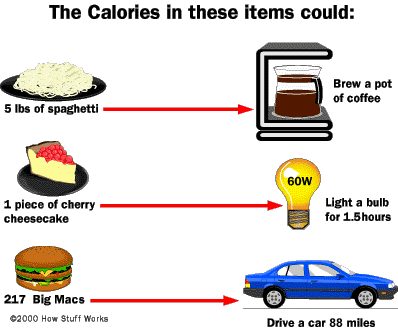
A calorie is simply a unit of energy. We attach it to food because that’s where we get our fuel, but the concept applies to anything with energy potential. Take a gallon of gasoline. It holds roughly 31,000,000 calories. That is a lot of energy packed into liquid.
Here is the technical definition: a calorie is the heat energy needed to raise the temperature of one gram of water by one degree Celsius. In physics terms, that is 4.184 joules.
But here is where it gets messy. When you look at a soda can and see “200 calories,” you are not seeing 200 calories. You are seeing kilocalories.
One kilocalorie equals 1,000 calories. Food labels drop the “kilo” prefix for simplicity. So, when a fitness chart says you burn 100 calories jogging a mile, it actually means 100 kilocalories. For the rest of this breakdown, we are using “calorie” to mean kilocalorie. It’s the standard language of nutrition, even if it’s technically imprecise.
The Energy Breakdown
Your body needs energy to keep the lights on. To breathe. To pump blood. To exist. That energy comes from food.
Not all food creates the same amount of energy. It comes down to three building blocks:
* Carbohydrates: 4 calories per gram.
* Protein: 4 calories per gram.
* Fat: 9 calories per gram.
Fat packs more than double the energy of carbs or protein. This is why understanding which foods provide sustained energy matters more than just counting numbers.
Let’s look at a packet of maple-and-brown-sugar oatmeal. The label says 160 calories. If you burned that oatmeal in a vacuum until it turned to ash, it would release enough heat to raise 160 kilograms of water by one degree Celsius.
But let’s dig deeper. The label breaks it down:
* 32 grams of carbohydrates (32 x 4 = 128 calories)
* 4 grams of protein (4 x 4 = 16 calories)
* 2 grams of fat (2 x 9 = 18 calories)
Total: 162 calories.
The manufacturer rounds down to 160. It’s a small discrepancy, but it shows how these numbers are estimates. Your body doesn’t just burn these numbers instantly. It breaks them down. Enzymes split carbohydrates into glucose. Fats into glycerol and fatty acids. Proteins into amino acids. These travel through your bloodstream to your cells. Some are used immediately. Others wait in storage for later.
Calculating Your Basal Metabolic Rate
So how much fuel do you actually need?
You might notice that nutrition labels use a 2,000-calorie diet as a baseline. That is an average. It is not a rule. Your specific needs depend on your height, weight, gender, age, and activity level.
To figure out your baseline, you have to look at your basal metabolic rate (BMR).
Your BMR is the energy your body burns just to stay alive at rest. It covers your heartbeat, your breathing, kidney function, and temperature regulation. It accounts for 60 to 70 percent of the total calories you burn in a day.
Men typically have a higher BMR than women due to muscle mass and body composition differences. But you can calculate your own number.
The Harris-Benedict formula is one of the most accurate ways to estimate this. It isn’t perfect, but it’s a solid starting point for understanding how to calculate your daily calorie needs.
Here is the math for men:
66 + (6.3 x weight in lbs.) + (12.9 x height in inches) - (6.8 x age)
Here is the math for women:
655 + (4.3 x weight in lbs.) + (4.7 x height in inches) - (4.7 x age)
Note the starting number for women. It is 655. Not 66. It seems arbitrary until you look at the physiological differences in baseline energy expenditure between sexes.
This formula gives you your resting burn. It doesn’t include the energy you use to walk to the car, lift groceries, or stress out over an email. That’s where physical activity and the thermic effect of food come in.
But without knowing your BMR, you’re just guessing. And guessing is expensive when it comes to your health.
The Hidden Costs of Moving and Eating
Physical activity is the second biggest chunk of your daily energy budget. It covers everything from the heavy lifting of moving furniture to the subtle burn of making your bed. You might think a brisk walk is negligible, but it adds up. The catch? The more you weigh, the more energy it takes to move that mass. A hundred-pound person burns fewer calories jogging than a two-hundred-pound person does.
Then there’s the thermic effect of food. This is the energy your body burns just to process what you eat. It sounds small, but it counts. Take your total daily intake and multiply it by 0.10. That’s your TEF. It’s not free energy. Digestion costs.
The 3,500 Calorie Rule
Here is the math that governs your waistline. If you eat 3,500 more calories than you burn, you gain a pound. If you burn 3,500 more than you eat, you lose a pound. The body is an efficient storage unit. It hoards excess energy as fat for a “rainy day” that never seems to arrive.
Exercise amplifies this deficit. But it doesn’t stop when you step off the treadmill. Your metabolism stays elevated for about two hours post-workout. You are still burning calories in the shower. You are still burning them while brushing your teeth. This is the “afterburn” effect. Use it.
A Calorie Is a Calorie (Sort Of)
If the goal is purely weight change, source doesn’t matter. A calorie from protein is the same unit of energy as a calorie from fat. Eat less, burn more, lose weight. Simple.
But if you care about health, the source is everything. Carbs and protein are leaner sources of energy. Fat is dense. It’s necessary for absorbing vitamins, but excess fat leads to serious health issues. The FDA says max out fat at 30% of your daily calories. Modern nutritionists often push for 25%.
For a 2,000-calorie day, that’s a hard cap.
30% = 600 calories from fat = 67 grams.
25% = 500 calories from fat = 56 grams.
It’s easy to blow past that limit with a single serving of oil or nuts.
The Fat Density Trap
Look at the numbers. They are shocking.
- Canola oil: One cup is 1,674 calories. 218 grams of fat.
- Peanut butter: One cup is 1,520 calories. 129 grams of fat.
- Cheddar cheese: One cup is 531 calories. 44 grams of fat.
Compare that to:
* Granola: One cup is 270 calories. 8 grams of fat.
* Chocolate syrup: One cup is 837 calories. 3 grams of fat.
* Sugar: One cup is 774 calories. 0 grams of fat.
Sugar has no fat. It’s pure energy. But it’s not food. Oil and peanut butter are healthful fats, but they are caloric bombs. You can eat a cup of granola and stay within your fat limits. You cannot eat a cup of canola oil and stay anywhere near healthy.
The math is unforgiving. You have to choose your calories carefully. Not just the number. The weight. The density. The source.
Where do your calories come from? That determines whether you are fueling a body or just filling a void. The choice is yours.