Strength and mobility get separated all the time. It’s the standard playbook. You lift heavy things then you stretch. One is about force. The other is about range. But what if you just did both at once?
Laura Kummerle says you can.
She’s a PT, a trainer, the founder of Paradigm of Perfection. She knows how joints move and muscles fail. Her point is simple enough but rarely practiced in gyms. You can build active range of motion while loading the tissue. Not after. During.
“You can in fact train strength and mobility at four the same time”
Here is how you do it without injuring your lower back on day one.
Straddle overhead lateral flex
This move targets the QL. The quadratus lumborum. That lower back muscle running from your ribs down to your pelvis? Yeah. It hates this exercise. Your obliques join in on the fun too.
Sit on the floor. Legs wide open like a gate. Keep your knees pointing up, not collapsing inward. Grab a weight with both hands. Press it overhead. Now bend to the side.
Reach for the ceiling while leaning toward one foot. Don’t let your ribs collapse. Stack the shoulders. It’s not about how far you drop. It’s about the muscle control required to return to the center. You’re stretching the spine. You’re also strengthening the wall that keeps you upright.
90/90 shifts from deep squat
Ankles. Hips. Core. This one hits the trio.
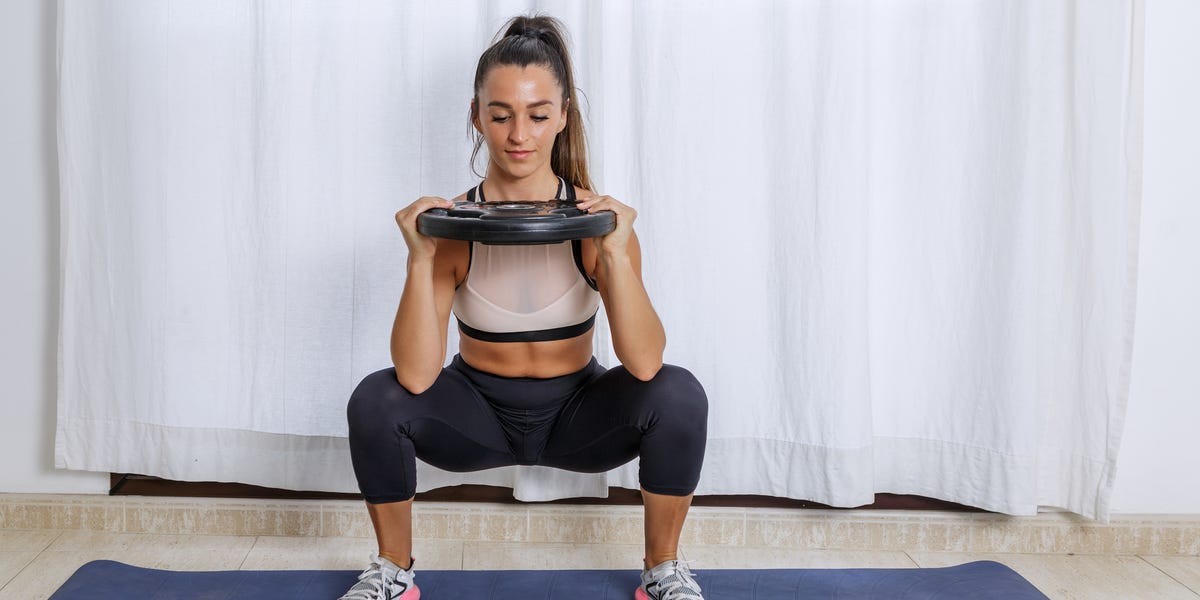
Start in a deep squat. Hips below the knees. Hold the weight in front of your shins for balance. This is key. The weight is a counterbalance, not a distraction. Shift your weight to the side. Lower into a 90/90 hip stretch. One leg forward, one out.
Then what? Stand back up.
That upward motion requires ankle mobility, hip flexibility, and raw core strength. If you can’t pull yourself out of that floor position, you don’t have the strength to match the stretch. Switch sides. Then do both legs at once and reach for the ground. A forward fold from the squat tests hamstrings and spine mobility.
Standing straddle shoulder extension
This looks easy. It isn’t.
Stand with feet wide. Hold the weight behind your hips. Hinge forward. Reach the weight overhead, aiming for the ground behind your back. It feels wrong at first. Shoulders burn. Hamstrings scream.
Kummerle warns against going heavy here. “Start with a super light load.” Why? Because few people train the upper spine and shoulder girdle in this loaded range. It demands thoracic extension you might have lost years ago. Come back up with control. Let gravity do the lifting is for other days. Here you control the descent.
Tall kneeling halo
Core stability meets shoulder rotation.
Get on your knees. Legs hip-width apart. Tall. Not slouched. Hold the weight with both hands. Circle it around your head. A halo.
Isometric core strength holds the posture steady while the shoulders work. Tight hip flexors get stretched too. If you’re sitting in a chair all day, your hip flexors are short and angry. This position opens them slightly. Switch direction. Do another circle.
Keep the head still. Let the weight move around you.
It’s a small movement. Quiet, almost. But the internal work is loud.