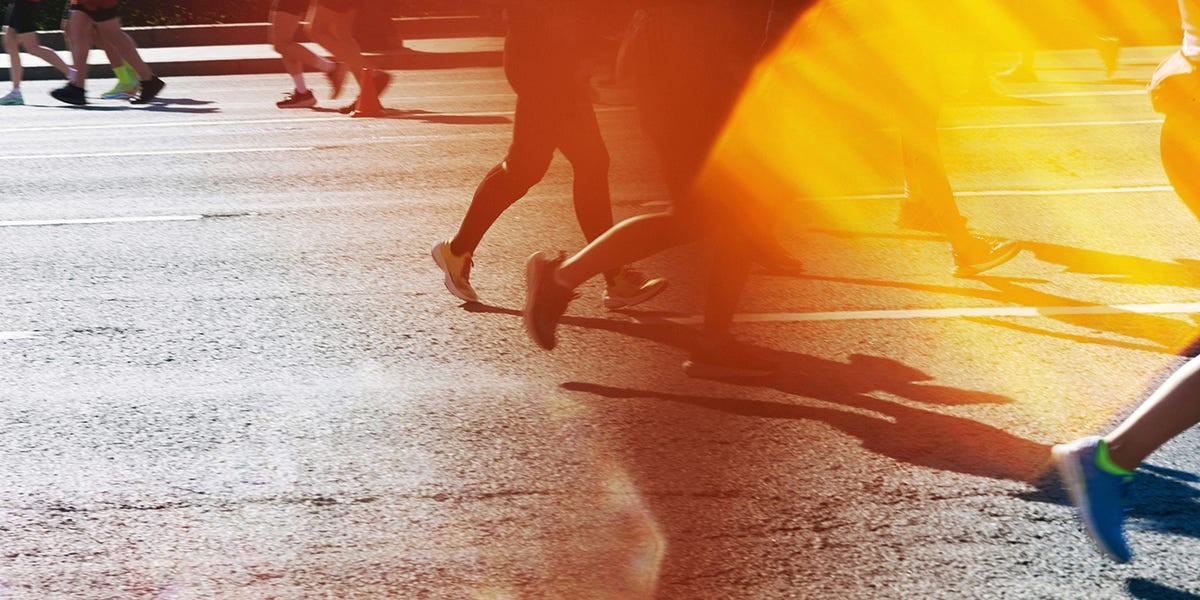
Jessica Lefkowitz thought she was ready.
Berlin. September 2025. Her second marathon. She wanted a sub-five-hour time, family in tow, halfway across the globe for it. Then she checked the forecast. Eighty-one degrees.
“I threw my goal out the window.”
Typically, late September in Berlin sits between 50 and 60. She hadn’t packed for hell. A few miles in, her clothes were soaked. She slowed. Other runners were vomiting on the sidelines, getting dragged into medical tents. She was thinking, “I want to die.”
Lefkowitz isn’t alone.
This is becoming normal. The World Meteorological Organization recently confirmed that the past decade-plus was the hottest in record. Races feel it. A Climate Central look at 221 marathons says 86 percent of them won’t have “ideal” running temps by 2050. Look at recent years: Shamrock in Virginia Beach. LA. Twin Cities. Brooklyn Half. Temps hitting 80s and 90s. Humidity maxed out.
People keep showing up though. Application records broke for New York, London, Sydney in 2026. The miles aren’t vanishing. They’re just hotter. Which means your old playbook doesn’t work anymore.
Train for the heat, not the miles
You can’t just train distance now. You need heat tolerance. The American College of Sports Medicine says your body needs two weeks to adapt to heat. But the mental part matters too. It’s hard. Really hard.
Live where it’s hot? Run during the day. Not 5 AM. When it’s miserable.
Live where it’s cool? Fake it. Get on the treadmill in a hot room. Kill the AC. Turn the heat up. Do it once or twice a week. Start small.
No treadmill? Wear extra clothes. A crisp 50-degree day? Throw on a long-sleeve shirt. Add a fleece vest. Make yourself sweat. Kelly Roberts, a certified run coach, says stay warm. Stay uncomfortable. Or, if you can afford it, go to the sauna or hot tub right after a hard run. Sit there 15 minutes. Don’t drink water during the heat exposure. Let your body panic a little. Just to learn.
Build this slowly. Add 10 percent more heat time per week. Like adding mileage. If you can swing it, fly into the race city three days early. John Jardine, a doctor at the Korey Stringer institute, suggests acclimatization. Your body needs time.
Fuel like it’s an emergency
Hydration isn’t optional anymore. It’s survival.
Salt your food four days before the race. Load up on electrolytes. Drink sports drinks. During the run? Sip like a clock.
Here’s the tricky part. Every body sweats differently. Clear pee isn’t enough data.
Find your sweat rate. Weigh yourself naked before a hot run. Weigh yourself naked after. The difference is water loss. Multiply that weight difference by 1.5. That’s what you need to drink per pound lost. Lose 2 pounds? Drink 48 ounces. Know your number so you don’t guess on race day. Sip. Don’t chug.
And then there’s bonking. When glycogen hits zero, your brain shuts down. You can’t think. “Your brain is literally struggling to stay coherent,” Roberts says. Heat makes bonking worse because sweating burns more fuel. Grab extra gels. Take them. You will thank me.
Cool down tricks that aren’t new
Gadgets are fun. Bluetooth trackers? Nice. Cooling vests? Maybe. But they’re not necessary.
Ice is free. And it works.
Cold water on your skin drops internal temp fast. Wear light clothes. UPF ratings help. A visor is better than a full hat—keeps the air moving over your neck. Put ice packs in your bra or your pockets. Simple physics.
Roberts says your training and mind matter more than any tech.
Treat your support team like a pit crew
Friends aren’t just for selfies at the start line. In 90-degree heat, they are mechanics.
Tell them where to stand. What to bring.
Hand them ice bottles. Pour water on your arms as you jog by. Cold things touching your skin drop your core temp. Use it.
Races are stepping up too. Cold sponges. Sprinklers. Look for signs. Know the map. Plan your cooling stops before you start running.
Zaley DeLeonardis-Page collapsed in Vermont in 2023 from heat stroke. Next race, she had her family ask her simple questions at pit stops. “How are you feeling?” Check her eyes. If she couldn’t answer, she knew. Mental status check is a real tool. Keep it safe.
Run the race that is there, not the one you planned
Months of work go into training. It hurts to slow down.
But the heat doesn’t care about your goal time. Your body prioritizes organs over speed. It dumps energy keeping your heart beating, your blood circulating. There is none left for speed.
If you slow down, you are being smart.
Lefkowitz hit mile 6 in Berlin and realized: I walk, or I die. She switched to walk-run. It felt wrong. She wanted to run. But she finished.
Organizers are waking up too. LA Marathon this year let people quit at mile 18. They still got a medal. Controversial? Sure. Did it work? Of the 22,000 finishers, 985 took the exit. Few medical evacuations. Two were even spectators. The doctors say it helped.
We keep running. The world keeps burning. You adapt. You drink more ice. You walk if you have to. The finish line is still there. But it feels farther away in July than it did in April.