


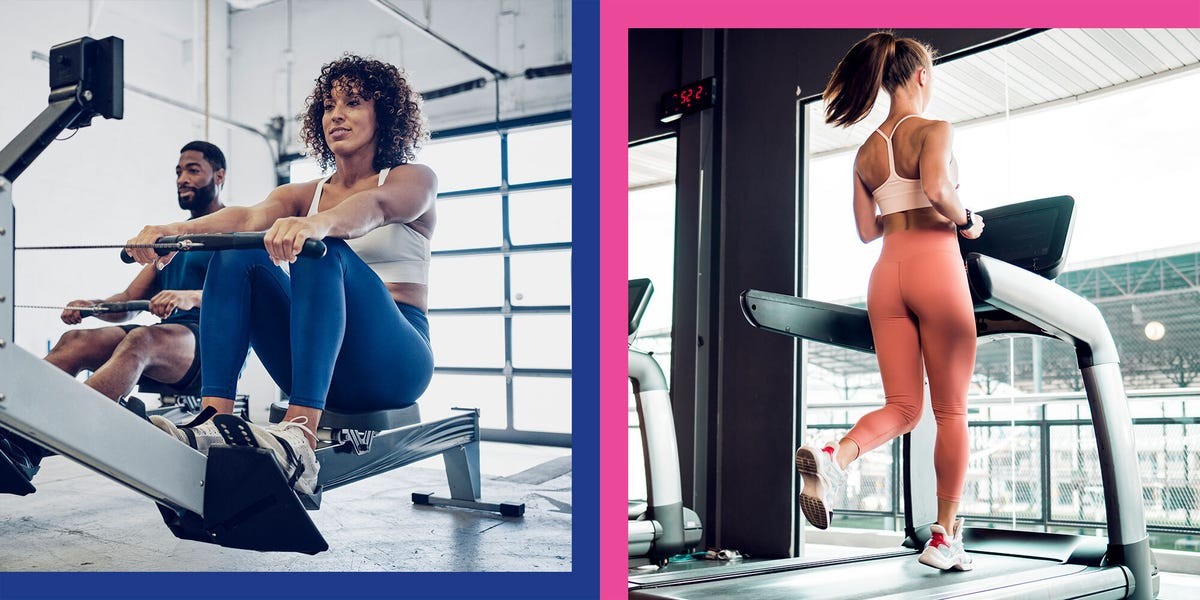
You show up at 5:30 p.m., ready to crush a run.
Then reality hits.
Every treadmill is occupied.
You skipped cardio for days, you feel the guilt creeping in.
Do you stand around waiting?
No.
You grab the nearest thing.
In this case, the rower.
Rowers get a bad rap. People think of sweaty CrossFit athletes or high school crews who look miserable. It feels intimidating. But it shouldn’t be. It is actually one of the better full-body, low-impact tools available.
Wait for the belt or hop on the slide?
“Both are excellent tools in the cardiovascular Health toolbox,” Sohee Carpenter PhD says. She’s a fitness coach on our advisory board. Let’s look at how they stack up.
The Cast:
* Sohee Carpenter, PhD, CSCSD. Fitness coach.
* Erica Coviello , CPT. Running coach, owner of Run Fit Stoked.
* Michelle Reno-Parolini *, CPT. Master trainer at RowHouse.
How They Hit Different Parts
Both make your heart pump. That is the easy part.
The mechanics? Completely different.
On The Treadmill
Erica Coviello notes that the machine just replicates the act of walking or running outdoors.
Simple, right?
Not quite. You are driving yourself forward. Quads, hamstrings, gluts, calves. Core stabilizes.
It builds power. It builds endurance.
But here is the catch: impact.
If you jog or run, you hammer your joints. Some experts say this increases bone density. That sounds good. If your knees hurt or you have past injuries though?
Ask a doctor.
Do not assume.
On The Rower
Michelle Reno-Parolini points out the key difference: recruitment.
Your arms move on the treadmill. Sure.
On the rower? You use them to actually move the machine.
Upper back. Biceps. Shoulders.
Plus, your legs. Quads and glutes push off the footplate.
This demands more energy. More calories burn. More oxygen flows.
You can hit moderate intensity without the joint smash.
The downside? Technique matters.
If your form is garbage, you waste energy. You get frustrated. You miss the point.
Reno-Parolini suggests hiring a coach for a few sessions.
Get it right first. Add it to the routine later.
Which One Wins?
Depends on what you want.
Fat loss? Muscle gain? Just wanting to survive the week?
Weight Loss
It is calories in vs. calories out. Always.
Reno-Parolini argues the rower wins here theoretically. Why? More muscles involved equals higher burn.
Assume equal intensity? The rower torches more fuel.
But Erica Coviello throws a wrench in that.
What matters most is consistency.
If you hate rowing? You won’t do it.
If you skip the rower because it feels weird? The treadmill burns nothing. Zero.
Pick the machine you will actually use.
Strength
Weight training builds strength. Obviously.
Cardio is secondary here.
That said, the rower edges out.
Resistance matters. Wind or water drag makes the machine fight you. You gain a bit more functional strength across the whole body.
The treadmill can help. Put it on an incline. Work those glutes and quads hard.
It’s not the same, though.
Cardiovascular Health
Carpenter says the machine type matters less than the habit.
How hard do you work? How often?
Aim for two zones.
- Zone 2. Low intensity. Think 70-80% max heart rate.
This builds mitochondria in muscle cells. These little guys create fuel for contractions. More of them means more energy, better performance. - High Intensity. 80% max or higher.
This strengthens the heart muscle itself. Improves blood pumping capacity.
The American Heart Association suggests 150 minutes low intensity weekly.
Or 75 minutes high intensity.
Mix it if you can.
Get Moving: Starter Workouts
New to this? Or just bored with your usual loop?
Here is how to start without getting destroyed.
For The Rower
Try intervals for a quick sweat.
Reno-Parolini recommends 30 seconds full effort. Then 30 seconds rest.
Repeat for five rounds.
This builds power and anaerobic threshold.
Feeling tough? Add more rounds. Go faster.
Prefer Zone 2?
Keep a slow, steady pace.
Start with 5 to 10 minutes.
As your body adapts, add time.
For The Treadmill
Intervals work here too.
Set the clock.
Run fast for 30 seconds.
Walk for 30.
Do five rounds.
Make it easier? Walk longer. Make it harder? Run faster or add a hill.
For steady state cardio, find a pace you can hold for 5-10 minutes.
Pop in a podcast.
Zone out.
Increase duration as you get stronger.
Making The Most Of The Iron
Do not just guess. Learn the tools.
Coviello notes modern treadmills have programs.
Auto-inclines. Interval sets.
Don’t hit the buttons manually. Let the machine work. Ask a staff member to show you the specific model you use.
Get Coached.
Especially on the rower.
Form is hard to self-correct.
A good trainer saves you from injury and helps you unlock the machine’s value.
Start Slow.
Carpeter warns against doing too much too soon.
Overuse injuries are real. They hurt. They last.
Start short. Start easy.
Let the body adapt.
What will you do tomorrow?
The machines will still be there.
Or maybe the treadmills will be open.
Who knows?
Just get moving. 🚣♀️🏃


