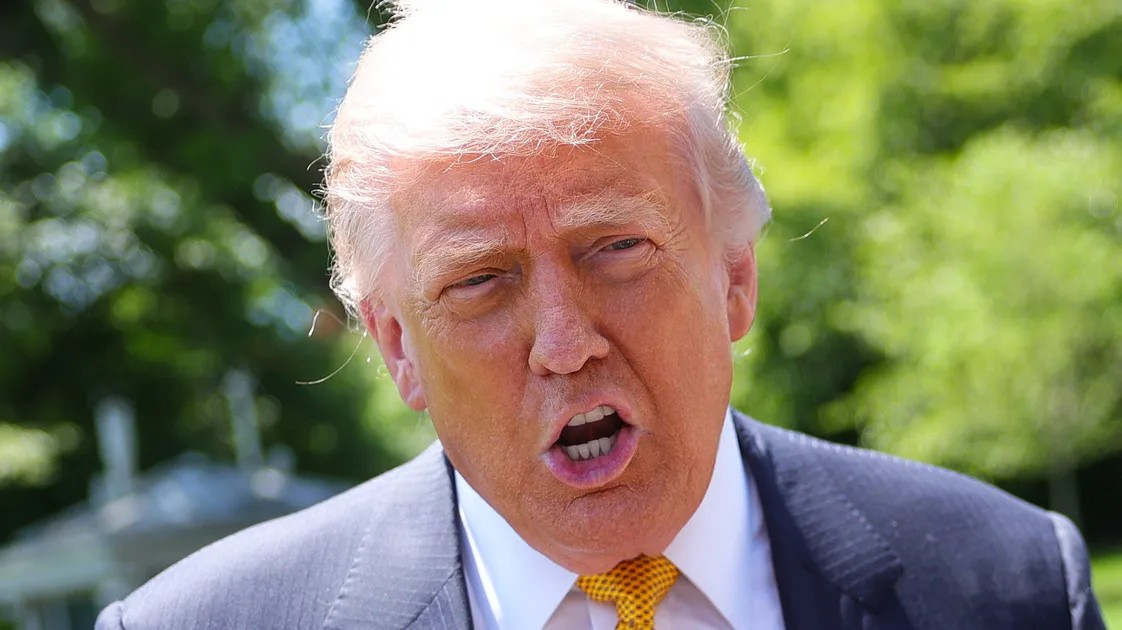
President Donald Trump recently engaged in a rapid-fire exchange of insults with two female journalists, labeling them “stupid” and “dumb” within minutes of each other. This incident, which occurred on the White House South Lawn before his departure for China, has drawn sharp criticism from political scientists who argue it reflects a consistent pattern of bullying and deflection rather than isolated outbursts.
The Context of the Insults
The confrontation began when reporter Akayla Gardner of MS NOW questioned Trump about the escalating costs of his White House ballroom project. Gardner drew a parallel between public criticism of Federal Reserve Chair Jerome Powell regarding cost overruns and the ballooning expenses of Trump’s renovation.
Trump rejected the comparison, claiming the project was ahead of schedule and under budget because he had doubled the size of the ballroom. When Gardner pressed him on the fact that projected costs had also doubled, Trump responded aggressively: “I doubled the size of it, you dumb person … You are not a smart person.”
Just moments earlier, Trump had directed similar vitriol at another female reporter who asked about surging U.S. inflation rates. When she questioned whether his policies were delivering on his promise to lower inflation, Trump defended his record by citing a brief period of low inflation prior to a military conflict. He then turned the attack on the journalist herself, stating: “If you go back to just before the war… let these lunatics have a nuclear weapon — if you want to do that, then you’re a stupid person… And you happen to be.”
A Pattern of Gendered Aggression
While the White House defended Trump’s remarks as “transparent” and unrelated to gender, experts point to a documented history of the president targeting female journalists with particular venom. Political scientists note that Trump frequently attacks the intelligence and appearance of women in the media, using derogatory terms that are less common in his interactions with male reporters.
This incident is not an anomaly. In the previous week, Trump slammed ABC News reporter Rachel Scott as a “horror show” and “one of the worst reporters” after she questioned why he was prioritizing renovations to the Lincoln Memorial Reflecting Pool while gas prices soared.
“Trump is ‘obviously sexist,’” said Todd Belt, a professor at George Washington University. “He doesn’t do this as often to men reporters as he does to women reporters. This is typical bullying behavior that he thinks he can get away with.”
The Psychology of Deflection
Experts suggest that Trump’s aggression serves a specific strategic purpose: deflection. By attacking the messenger, he shifts the focus away from substantive policy failures or controversial projects.
Todd Belt explains that the ballroom project is a point of pride for Trump, serving as a symbol of his developer prowess. Criticism of this project strikes at a personal level, prompting a defensive overreaction. Similarly, inflation is a politically sensitive topic where Trump feels vulnerable. By insulting the reporters, he attempts to control the narrative and dismiss valid economic concerns as the product of “stupid” or malicious actors.
Jacob Neiheisel, an associate professor at the University at Buffalo, argues that this behavior is becoming normalized in political discourse. “Unfortunately, Trump’s episodes of snapping at reporters are so common that they are starting to recede into background noise,” Neiheisel noted, suggesting that the tactic may be intended to desensitize the public to presidential misconduct.
The Broader Implications for Democracy
The use of personal insults by a sitting president raises significant concerns about the health of democratic dialogue. Todd Belt identifies Trump’s tactic as DARVO (Deny, Attack, Reverse Victim and Offender), a manipulative strategy often associated with abusive relationships. By reversing the roles, the abuser positions themselves as the victim of unfair criticism.
Neiheisel emphasizes that questions about government spending—whether on ballrooms or inflation—are fundamental to public accountability. “It’s perfectly fair to want a robust public conversation about how government monies are spent,” he said. When leaders respond to such questions with personal attacks rather than data or explanation, they erode the trust necessary for a functioning democracy.
“On a broader level, maybe we’ve just come to a place with our politics that internet trolling behavior is widespread,” Neiheisel observed.
Conclusion
Trump’s recent insults toward journalists are not merely personal slights but calculated moves to deflect criticism and assert dominance. While his administration frames this as transparency, experts warn that this pattern of abusive, gendered rhetoric undermines serious political discourse and normalizes toxic behavior at the highest levels of government.